The Sixth Sunday of Lent: The Passion of Christ

Updated: Apr 1
Matthew 26:14-27:66
In This Gospel
Jesus is betrayed, denied, condemned, and crucified. On Palm Sunday, the Church places the full Passion before us. We follow Jesus from the Last Supper to the cross and see how different people respond to Him along the way.
Context
Holy Week begins where Lent has been leading. In recent weeks, we have heard stories of repentance, mercy, healing, and new life. Now the Church brings us into the Passion, where Jesus freely enters suffering and gives Himself completely for us.
We begin at the Last Supper, where Jesus breaks bread with His disciples and institutes the Eucharist. He then prays in Gethsemane, is betrayed by Judas, denied by Peter, brought before Pilate, and led to the cross.
As we move through the Passion, we examine our hearts. Reflecting on Judas, Peter, Pilate, the crowd, and the men beside Jesus, we ask where we see ourselves in their actions, choices, and responses to Him.
Judas Betrays Jesus with a Kiss
Judas, one of the Twelve, approaches Jesus with a kiss and identifies Him to those who have come to arrest Him. Later, Judas is overcome with remorse when he sees what his betrayal has set in motion.
Betrayal often begins long before the outward act. It can begin in jealousy, resentment, dishonesty, or hidden disloyalty. Sin often grows quietly before it becomes visible.
Reflection
When have we been jealous of another person’s success or gifts? When have we tried to tear someone down in order to build ourselves up?
Peter Denies Jesus Three Times
At the Last Supper, Peter insists that he is ready to go with Jesus to prison and even to death. Only hours later, in the high priest’s courtyard, Peter denies knowing Jesus at all.
Fear can cause us to fold in moments that call for courage. Pressure can expose how fragile our confidence can be when it has not yet been tested.
Reflection
Do we tend to face challenges with fear, or with hope and trust in the Lord? When has pressure caused us to compromise our beliefs and morals?
Pilate Knows Jesus Is Innocent, but Still Condemns Him
Pilate says that he finds no guilt in Jesus. He even tries to release Him. As the pressure around him grows, he gives in and hands Jesus over to be crucified.
Sometimes it is easier to avoid responsibility than to face it. Weak leadership, self-protection, and fear of public reaction can still do real harm. Refusing to act can become its own form of participation in evil.
Reflection
When have we burdened others by avoiding our responsibilities or ignoring our faults? When have we chosen comfort over our duty to love, protect, or speak up?
The Crowd Shouts for Jesus to Be Crucified
Stirred up by the chief priests and elders, the crowd joins in the cry, “Crucify Him.” Even after Pilate says that Jesus has done nothing deserving of death, they continue to demand His crucifixion.
The crowd reminds us of the power of our voices. People can be swept up by emotion, manipulated by influence, and emboldened by numbers. A crowd can normalize what individuals might never have chosen alone.
Reflection
When have we been too quick to judge or joined in gossip that tears down someone’s character? When have we been silent and complicit in the face of injustice, discrimination, or evil?
Two Men Hang Beside Jesus
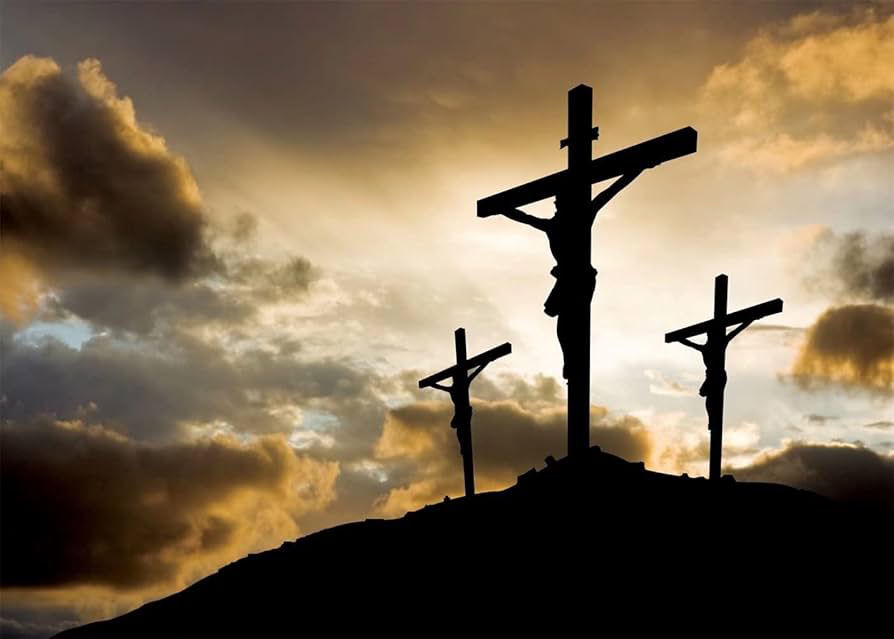
Two criminals are crucified beside Jesus. One joins in the mockery. The other acknowledges his own guilt, recognizes Jesus’ innocence, and asks to be remembered in His kingdom. Jesus promises that he will be with Him in paradise.
Suffering can harden us, or it can humble us. One man closes himself further. The other opens himself to mercy. Even at the edge of death, repentance remains possible.
Reflection
Have we hardened our hearts and failed to make room for forgiveness, reconciliation, or mercy? Have we given up on ourselves, forgetting that God never gives up on us?
Jesus Enters This Suffering Fully
Jesus is betrayed, denied, accused, mocked, and crucified. In the middle of suffering, He continues to surrender Himself to the Father, to love, and to remain near even those who fail Him.
Jesus reveals the fullness of His humanity. In Gethsemane, He asks the Father if this cup might pass from Him. On the cross, He cries out, “My God, my God, why have you forsaken me?” He enters fully into human anguish, pain, and abandonment.
Jesus prays Psalm 22 from the cross. That psalm begins in anguish but ends in praise: “I will proclaim your name to my brethren; in the midst of the assembly I will praise you.” Even in suffering, Jesus remains in communion with the Father.
The Passion of Christ Is About Hope, Love, and Redemption
Each character in the Passion reveals brokenness and failure, but in Jesus there is always room for redemption. Peter denies Jesus three times, yet he is not discarded. The repentant thief is received with mercy. Jesus continues to love in the middle of rejection.
The Passion shows the depth of human sin, but even more, it reveals the depth of divine love. Christ enters suffering not as a victim of chaos, but as the Savior who gives Himself for the life of the world.
Closing Prayer
Lord Jesus, You are our Redeemer, who gave Your life for us in love. You thought of us on the way to Calvary and remembered us on the cross. Help us remember our worth, knowing that You chose us and made eternal life possible through Your great sacrifice. Amen.

Comments